
Our Managing Director has just celebrated her 10th anniversary at TSIC, and here’s a recount of her highlights and reflections on the 10 years.
We have a famous saying in Cantonese, coming from a popular TV show, “How many ten years are there in a lifetime?” Life is short and a decade is a long time. But it is also that type of milestone that calls for pause and reflections.
According to my cover letter to apply for the Analyst position at TSIC written in July 2014, “TSIC appeals to me because of its impact, global exposure and work environment”:
- I enjoy the real impact made to the clients and society.
- TSIC gives me the exposure to learn about social entrepreneurship in a global context. Given my expertise in Asia, I am especially interested to find out how the UK, as a global leader in social enterprise, can inform this hugely untapped sector in Asia.
- I thrive in a collaborative and dynamic environment with a flat hierarchy. TSIC allows me to work with like-minded, talented individuals who want to change the world.
It is perhaps reassuring that these three points still hold true today. Ten years on, TSIC has grown to ten times the size when I first joined the tight-knitted team of four, and I’d like to believe that our impact has grown a lot more than tenfold.
I want to share three very formative moments in my early days of TSIC, that shape my own view and the work that TSIC continues to do today.
Social Entrepreneurship and systems change
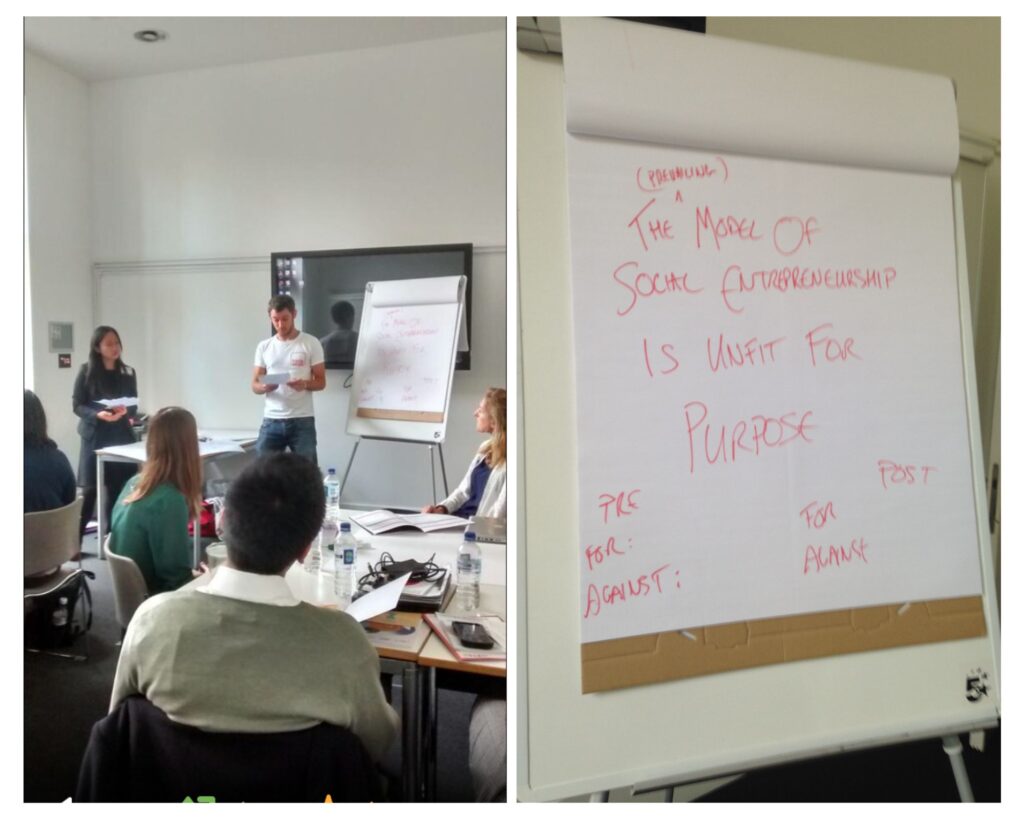
My first interaction with TSIC was even before I joined as a staff member. I joined TSIC’s workshop at OxfordJam, the fringe event to Skoll World Forum, in 2014. They were hosting a workshop titled “The Flawed Cult of the Social Entrepreneur: Is Your Social Enterprise Stopping You Having the Impact You Could?”. The aim of the workshop was to challenge social entrepreneurs to rethink the normal route: building organisations that deliver direct interventions to treat problems. Can social entrepreneurs do more good for less by aiming to inform others, strengthen systems and/or collaborate instead of insisting on protecting and scaling a direct intervention? It wasn’t just a theoretical workshop – TSIC also had been incubating Future First, a charity in the UK aiming to address social mobility, and used its first-hand experience to shape the workshop.
I was one year into building my own social enterprise at the time and felt the pressure to protect my own intervention, prove that my idea was unique in order to attract funding. Joining the workshop was a breath of fresh air to help me think differently about scaling impact. I really appreciated that TSIC was willing to speak truth to power, in pursuit of impact – that attracted me to join the organisation and to this day, it is still the value I hold most dear in TSIC. That workshop also opened my mind to creating systems change – individual social entrepreneurs will struggle to change systems, and we should always be ambitious about pursuing systems change – which is also what TSIC seeks to help clients to achieve.
Equity and inclusion
I was taking the metro in Hong Kong when I received the phone call from Claire Arnott, who then became my manager at TSIC – and is still a dear Associate of TSIC today. I was over the moon with the news, went back to London and started working at TSIC in mid-September. My first project was to conduct research for MSDUK, which champions supplier diversity, particularly the inclusion of Ethnic Minority Owned Businesses (EMBs) in corporate and public sector supply chains, under the inspiring leadership of Mayank Shah. The result was “The Road to Inclusive Procurement” report, which was launched in the House of Lords.
I had been in the UK only for a year, and the project exposed me to the challenges faced by ethnic minorities – which I realised I was now part of – in this country, in terms of access to business contracts, finance and scaling their businesses. It was so informative and it enabled me to have a strong diversity, equity and inclusion lens in my subsequent work, leading to the formation of Diversity Forum for Inclusive Social Investment in 2016, and Pathway Fund, an impact investment initiative focused on racial equity in 2020. I would credit TSIC’s early work on topics such as racial equity, that have shaped my own focus; as well as our continual reputation in the sector.

Global network
What intrigued me about TSIC was its global network – it was rare for an organisation, so rooted within London and the UK, to also have a global footprint. I remember Founder of TSIC, Jake Hayman, freshly returned from trips to Kazakhstan and Rwanda; and we also had an office in Dubai under the leadership of Farah Williamson. Back in 2013, TSIC had the foresight to build a Franchise model – which enables individuals, with ambitions to start their own social impact consultancy but don’t want to start from scratch or reinvent the wheel, to do it under the TSIC umbrella. I really loved the franchise model and saw how it enabled us to do some very impactful projects, such as supporting UNICEF expand their giving strategy to the Gulf. Since joining TSIC, I’ve focused on expanding the global network and our staff time and again say that the diversity of TSIC is our strongest asset.
TSIC’s global outlook was also why it took a chance on ‘immigrants’ such as myself and Dr. Rachel Linn, who came to the UK from the US as a Gates scholar, who led a lot of our rigorous research work; and despite being a very small company at that point, already sponsored our visas to work here. The UK confronts a very different set of socioeconomic and political challenges compared to 10 years ago when I joined, but I think our continual dedication to nurturing a diverse workforce – regardless of gender, race, religion, nationality, disability and other characteristics – is more important than ever.

Looking ahead
I don’t know where the next 10 years will take me, but I hope whatever happens, TSIC will continue to build on its strengths: challenging clients to be ambitious about systems change, having an unwavering commitment to diversity, equity and inclusion, and continuing to cultivate and elevate our global network.