
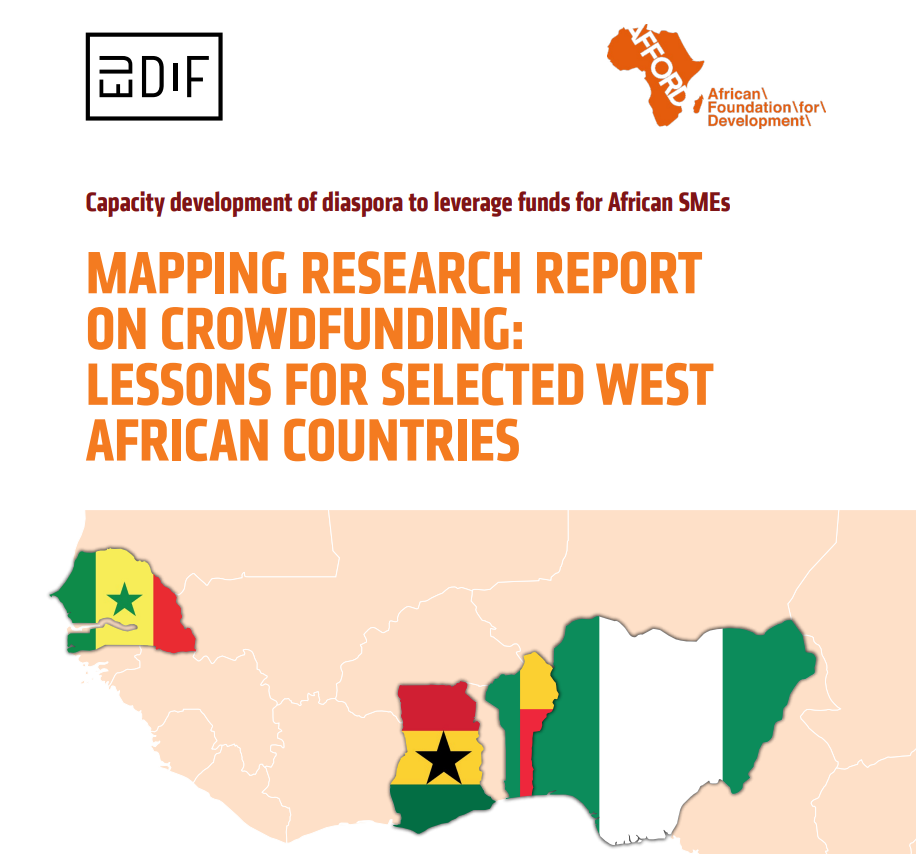
The European Union’s Global Diaspora Facility (EUDiF) has published a report by The Social Investment Consultancy Africa (TSIC Africa) on the role of crowdfunding in improving access to finance for small and medium-sized enterprises (SMEs) in West Africa. Developed in collaboration with the African Foundation for Development (AFFORD) and the International Centre for Migration Policy Development (ICMPD), this research forms part of the EUDiF initiative, focused on empowering diaspora organisations and entrepreneurs to drive sustainable development.
The report, Mapping Research Report on Crowdfunding: Lessons for Selected West African Countries, provides a comprehensive assessment of the crowdfunding landscape across four key countries in the region – Benin, Ghana, Nigeria and Senegal – selected under AFFORD’s ABC West Africa programme. Drawing insights from more advanced crowdfunding ecosystems such as the United Kingdom, India, China, the United Arab Emirates and the United States, the report serves as a valuable reference for policy-makers, investors, and ecosystem builders alike.
At its core, the research explores a timely question: how can diaspora communities better leverage crowdfunding to invest in, support, and accelerate the growth of SMEs in their countries of origin?
To answer this, TSIC employed a mixed-methods approach, combining desk research, key informant interviews, focus group discussions, and surveys among diaspora members and African SMEs. The findings shine a light on both the immense opportunities and the systemic challenges within the current ecosystem.
Key findings from the report include:
A fragmented regulatory environment
Crowdfunding in West Africa remains largely unregulated or inconsistently governed. Clearer and more enabling regulatory frameworks are urgently needed to support a variety of crowdfunding models, including donation-based, rewards-based, equity-based and crowdlending approaches.
Diaspora as a critical but underutilised player
The diaspora already plays a significant role in crowdfunding across the region, but its involvement remains informal and ad hoc. The report identifies a strong need for more structured engagement, targeted capacity-building, and streamlined investment pathways to enable diaspora investors to act as key partners in SME growth.
Barriers to participation
Regulatory ambiguity, limited public trust in digital platforms, lack of awareness, and restricted local participation continue to hamper crowdfunding’s potential. Overcoming these barriers will be essential for scaling access to finance in inclusive and sustainable ways.
Opportunities for transformation
Adapting crowdfunding models to suit local financial and cultural contexts, combined with the development of relevant educational materials and the fostering of public-private partnerships, can help catalyse the growth of a robust and trusted crowdfunding ecosystem in West Africa.
From Research to Action
The research has already informed several key initiatives under the broader EUDiF and AFFORD collaboration. Notably, it served as the basis for the development of a tailored training curriculum for diaspora investors and African SMEs. This curriculum has since been delivered through a series of online and in-person workshops held between 2023 and 2024.
Additionally, the report’s findings were at the centre of discussions at the 8th Diaspora Investment and Policy Forum (DIPF), held in March 2024 under the theme “Access to Finance: Challenges and Opportunities of Crowdfunding and Product Certification for SMEs in West Africa.” This virtual policy dialogue brought together over 60 participants, including policymakers from Europe and West Africa, providing a platform to unpack the report’s recommendations and explore pathways for implementation.
Why Diaspora Investment Matters
The release of this report comes at a time of growing global recognition of the power and potential of diaspora finance. According to the African Development Bank, the 140 million Africans living outside the continent save up to $53 billion annually in their host countries. Remittances from these communities now rank as the second-largest source of external finance for the continent—outpacing Official Development Aid (ODA) and second only to Foreign Direct Investment (FDI).
With traditional development aid on the decline, diaspora bonds, crowdlending, and other innovative finance mechanisms are emerging as critical strategies for Africa’s long-term transformation. The African Union (AU) recognises this potential, having designated the diaspora as Africa’s “sixth region” and launching the “Decade of African Roots and Diasporas” (2021–2031) to strengthen ties between diaspora communities and the continent. This vision seeks to unlock the diaspora’s role in economic growth, cultural exchange, and political development.
Mapping Research Report on Crowdfunding: Lessons for Selected West African Countries – EUDiF
What’s Next
TSIC UK and Africa continues to partner with AFFORD in advancing diaspora-led investment as a viable and scalable financing pathway for Africa’s development. Our collaboration is expanding to new territories, including Sierra Leone, where TSIC have been working on strategic initiatives to deepen diaspora investment. We look forward to leveraging this work to other African countries.
As the global conversation around innovative finance evolves, we remain committed to locally-led development structures through delivering actionable insights and evidence-based strategies that help bridge the finance gap for SMEs and unlock new forms of capital for social impact in African countries and beyond.
To explore the full findings and recommendations, access the report here.