

At TSIC, we’ve been reflecting on something that sits at the very heart of what we do – knowledge. What is it, really? How do we engage with it as consultants? And with AI rapidly reshaping the knowledge economy, what might we need to do differently?
These questions sparked our recent internal learning session – part theory, part therapy, and surprisingly energising. Here’s what we uncovered.
Why This, Why Now?
We operate in the knowledge economy. In many ways, we’re knowledge intermediaries: translating, synthesising, and surfacing information so others can make better decisions. But in a world where AI can summarise reports, categorise stakeholder input, and identify trends, we have to ask: what do we offer that machines can’t?
The session gave us space to unpack this, both to understand our value and to explore how we might evolve to meet a future where knowledge work is changing fast.
The Framework: Known and Unknown Dimensions of Knowledge
We built our conversation around a deceptively simple framework inspired by Donald Rumsfeld’s infamous classification of knowledge:
- Known Knowns: What we’re aware of and understand
- Known Unknowns: What we know we don’t know
- Unknown Knowns: What we understand deep down but aren’t aware of
- Unknown Unknowns: What we don’t even know we don’t know
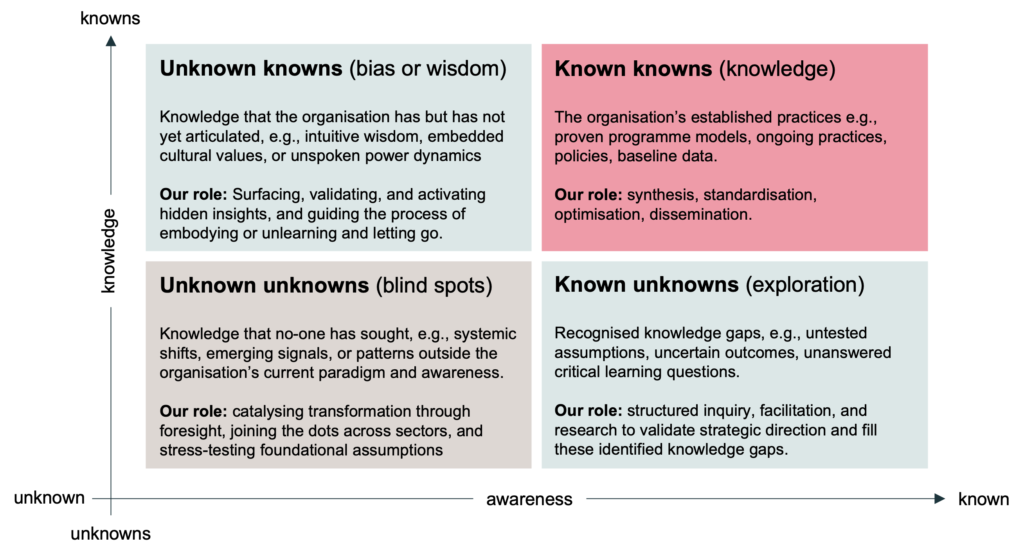
Mapped against axes of awareness and understanding, this model gave us a new way to think about our role in client work, and the value we bring in each quadrant.
How This Shows Up in Our Work
We realised that most of our consultancy work, especially evaluations, desk reviews and literature syntheses, sits in the “known known” space. The client knows it, we know it, and we package it up clearly. But this space is increasingly ripe for disruption by AI.
Clients also often operate in the “known unknown” space – they’re aware of gaps and ask us to help fill them. Think: outcomes they’re unsure they’ve achieved, assumptions they’ve not tested, or learning questions they’d like to be answered. Here, our value lies in our facilitation, reflection, and structured inquiry.
But the magic (and the messiness) often lies in the other quadrants.
In the “unknown knowns”, we help surface things clients already understand intuitively: unspoken power dynamics, embedded assumptions, or cultural values they haven’t yet articulated. We may need to unlearn and let go, to get to the deeper truths. These moments can be powerful. But they can also be vulnerable, and sensitive, and clients (as well as us) may not always be emotionally ready for the mirror we hold up.
In the “unknown unknowns”, we can make use of our unique position as catalyst for change – drawing insights from other sectors and countries, perspectives from lived experience, or patterns across projects that clients haven’t considered. This space requires ‘joining the dots’, but it’s also where transformative insights often begin.
Foresight gives us a way to work more intentionally in this space. Rather than predicting the future, it helps us explore a range of possible futures, even uncomfortable ones, and challenges linear assumptions about how change happens. By drawing on systems thinking, it encourages us to consider interdependence, emerging signals, and the broader context our work sits within. This perspective can bring both vision and courage to our strategy and evaluation work.
Some Key Reflections: What We Learned
We would like to operationalise the theory of knowledge more within the team, in order to create more value for our clients and the social impact space. A few strong insights emerged:
- We’re strongest in “known knowns”, but that’s also where we’re most at risk.
Synthesis is valuable, but easily replicated. We need to consciously move into more complex, relational, and intuitive forms of knowledge if we want to remain relevant. - Clients may think they want a report, but often need a shift in thinking.
This mismatch can lead to disappointment if left unspoken. But when handled well, it’s an opportunity for deep value and trust-building. - The human edge lies in lived experience, emotional nuance, and meaning-making.
AI can’t replicate what it means to sit with discomfort, navigate relationships, or hold space for difficult truths. These are core parts of our work, and strengths we should lean into. The disruption that comes with AI, may provide more space for us to look deeper within ourselves. - Surface the unknown gently.
Uncovering blind spots can be powerful, but also unsettling. Emotional maturity, trust, and careful communication are essential when guiding clients into uncharted knowledge.
What This Means For Us
So, how do we act on all this? Here’s what we’re thinking:
- Try introducing it in early conversations. It can help clarify expectations: are they asking us to confirm what they already know, or explore what they haven’t yet uncovered?
- Reflect on your own ‘knowledge posture’.
In each project, ask: Which quadrant am I operating in? Could we shift? What’s needed: time, trust, facilitation skills? - Build emotional fluency.
Supporting clients through emotional or political complexity isn’t something we’re always trained for, but it’s a critical skill. We’ll invest in it. - Spot and share patterns across projects.
Sometimes we see what clients can’t. We’ll find ethical and respectful ways to surface those unknowns, whether through cross-sector insights or lived experience.
A Final Thought
As one colleague put it during the session: “AI can structure my thoughts – but not feel them, not live them.”
And that’s it, really. Our edge isn’t just knowledge. It’s empathy, relationship, and insight born from experience. As the landscape shifts, we are aiming not just to adapt, but also to deepen, and lean more into the unknown.