
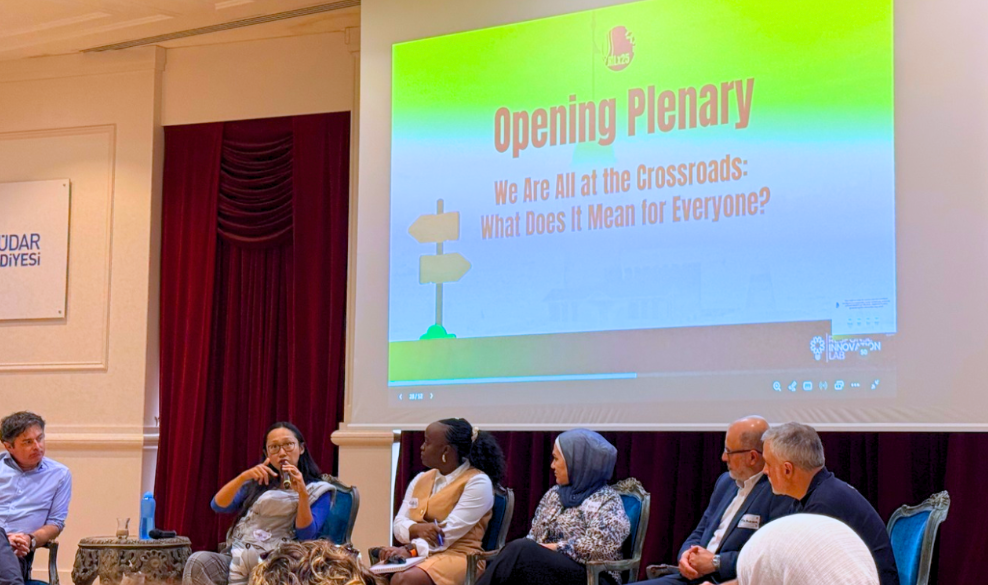
Our Managing Director, Bonnie Chiu, was invited to deliver an opening provocation at the Response Innovation Lab Exchange (RILx) 2025, in Istanbul, reflecting on her journey of channeling impact investment. This blog is an adaptation of her opening provocation.
I was in Istanbul when four Turkish girls came up to me and asked for a photo. In that brief exchange, something became clear to me: we often have far more in common than what divides us.
That moment has always stayed with me. It later shaped the way I think about impact, power, and connection — first as the founder of a global social enterprise, and now as an advisor to investors working across complex social and humanitarian contexts.
Photography is often described as a universal language. It connects across borders, cultures, and experiences.
Finance, or money, is also a universal language. But too often, instead of connecting, it divides.
This tension sits at the heart of impact investing today. Capital has enormous potential to bridge gaps between intention and outcome, resources and need. Yet in practice, it frequently reinforces distance — between investors and communities, decision-makers and lived experience.
At The Social Investment Consultancy (TSIC), our work starts from a simple question: what does it take for capital to genuinely connect, rather than merely deploy?
Intentionality Is an Ongoing, Two-Way Process
Impact investing is commonly defined as the deployment of capital with the intention to generate positive social or environmental outcomes alongside financial returns.
In practice, intentionality is often treated as something investors declare at the outset — a theory of change (ToC), a set of metrics, a list of priority themes. We have sometimes described ToC as a tool of control Goals are frequently set by distant decision-makers with limited proximity to context.
Our experience suggests something different. Intentionality is not a fixed declaration. It is a process of co-creation.
At Lensational, the social enterprise I founded to equip women around the world with cameras and training, we did not define impact in advance and ask participants to fit into it. Women told us what impact meant to them: voice, dignity, and income they controlled. Those priorities reshaped our model.
Later, advising funders and asset owners, I saw how often definitions of impact are written far from the communities they are meant to serve. When that happens, finance’s so-called universal language becomes a code that only a few can speak. In that, jargon is built in, and power is reinforced.
Technical language, compliance processes, and reporting requirements can unintentionally exclude local actors from meaningful participation.
When communities are not involved in defining outcomes, investment risks becoming projection rather than partnership.
From an advisory perspective, this is not simply a moral concern. It is a material one. Misaligned intent increases execution risk, weakens outcomes, and erodes trust — particularly in fragile and humanitarian contexts.
Capital connects when people most affected by investment decisions are involved in framing what success looks like — and have agency in shaping the picture.
Don’t Fund the Inevitable. Fund the Invisible
Another core principle in impact investing is additionality: capital should enable outcomes that would not otherwise happen.
In reality, much impact capital gravitates toward what already feels legible — established organisations, familiar intermediaries, and proven models with polished track records.
When I was 20, a social enterprise competition judge once told me, “You’re bright — get a job, don’t worry about your little side project.” Instead, I started Lensational anyway, as a Facebook page and a small group of supporters. We were not inevitable. We were invisible.
Having been rejected as a founder in my early days has shaped our view that the capital that mattered most was not money that validated existing success, but money that created new possibility.
At TSIC, we apply the same lens when working with investors. We help redesign portfolios to back what markets routinely miss: women-led organisations, local intermediaries, and early-stage innovation. Pathway Fund, a new impact investment wholesaler focused on racial equity that TSIC is proud to incubate, is one example of how intentional portfolio construction can shift who has access to capital — and on what terms.
If deal flow never changes who is in the frame, capital may be labelled impact — but it is not additional. It is decorative.
Measurement Without Meaning Distorts Impact
Impact investing has become increasingly sophisticated in how it measures outputs, ratios, and returns. Indeed, measurement of impact is part of the definition of impact investment.
This discipline matters. But not everything meaningful is easily measured.
In photography, what gives an image its power is not always what is in sharp focus. Sometimes it is what is blurred — a gesture, a relationship, a sense of trust.
Impact is similar. Human relationships, dignity, belonging, and agency are often the outcomes that matter most to communities — and the ones most likely to be lost when measurement becomes too narrow.
There is a further blind spot. Investors are adept at evaluating what their partners deliver. They are far less likely to evaluate their own contribution.
Capital can create harm as well as benefit: pressure to conform to investor timelines, subtle extraction of narrative control, or displacement of local priorities. Yet these effects are rarely examined with the same rigour as financial performance.
In our consulting work, we increasingly encourage investors to ask themselves the same questions they ask others: what impact is your capital having on the ecosystem? Are you making systems more inclusive — or more extractive?
Finance connects when investors learn to see the invisible threads of power, trust, and accountability, not only the visible metrics.
Moving Beyond the Extractive Logic of Finance
In humanitarian and fragile settings, the limitations of conventional impact investing become even more pronounced.
Political, social, and racial inequalities shape who is able to innovate and who is able to access capital. Women-led and locally led solutions often struggle to attract funding not because they lack potential, but because systems of trust and decision-making are stacked against them.
Bureaucracy, risk intolerance, and data requirements add further barriers — particularly where infrastructure and stability are limited.
Importing market logic wholesale into these contexts can do real damage. If impact investing is to serve humanitarian goals, capital must bend to people, not the other way around.
That means allowing local actors to define success, building flexibility into timelines, and holding investors accountable for whether their capital shifts power or reinforces existing hierarchies.
In these settings, the most meaningful innovation is often not a new financial instrument, but a new set of power dynamics.
Capital as a Bridge
My own journey has reinforced one core belief. Capital is a bridge.
Bridges only hold when they are anchored on both sides: on one side, in rigorous financial thinking; on the other, in community power and justice.
When capital is designed this way, finance can begin to resemble photography— not as a tool of extraction or control, but as a way of seeing more clearly, a way to honour dignity, and a way to connect, across borders and barriers.
And in that, it holds the promise to enable the humanitarian and development sector, at the crossroads, towards achieving transformative potential.