
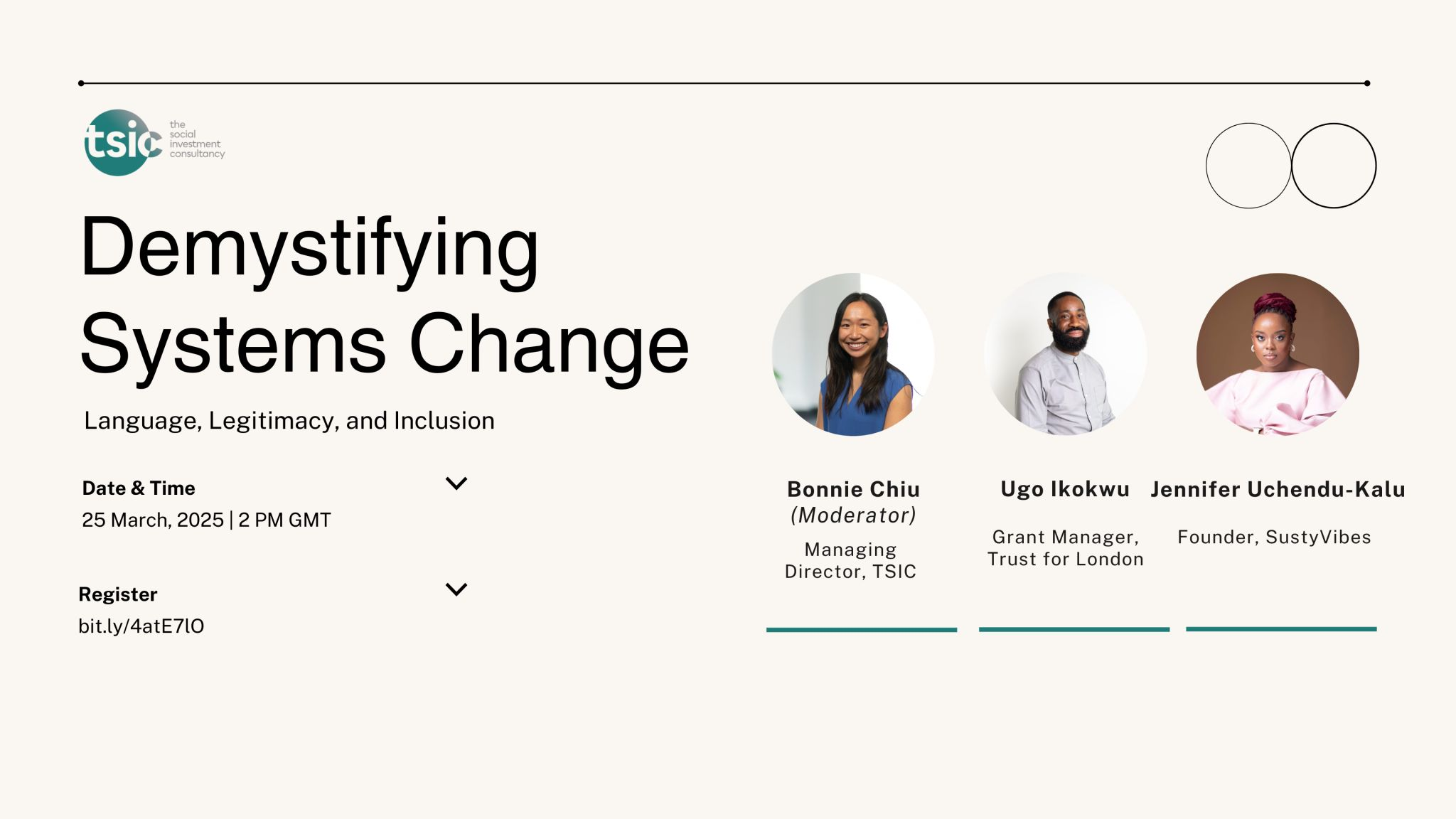
Following a recent TSIC webinar moderated by our Managing Director, Bonnie Chiu, featuring Jennifer Uchendu-Kalu, Founder of SustyVibes, and Ugo Ikokwu, Grants Manager at Trust for London, the conversation explored how language influences inclusion, legitimacy, and participation in the social impact sector. At the centre of the discussion was an important question: if the goal is equity, why does the language around it often feel exclusionary?
When Language Creates Distance
The discussion highlighted how language can create unnecessary distance between institutions and the communities they hope to serve. Across funding, philanthropy, and social impact spaces, terminology that is intended to clarify ideas can sometimes do the opposite. Concepts such as systems change may be familiar within professional circles, yet feel abstract or inaccessible to those already doing the work on the ground. When people are expected to translate their experience into an unfamiliar language, valuable insight can be lost.
Another theme that emerged was authenticity. Many organisations are already challenging inequality, building local wealth, strengthening resilience, and shifting power in practical ways. Yet their work is not always recognised if it is not described using the “right” words. This creates a tension where language can become a test of credibility rather than a reflection of impact. In some cases, the clearest and most meaningful ideas only surface once jargon is removed.
Do Our Metaphors Translate?
The conversation also reflected on the metaphors often used in the sector, from icebergs to flowing water. While these frameworks are designed to simplify complexity, they do not always translate across cultures or lived realities. More grounded language, such as trust, land, power, culture, survival, and community, often resonates more deeply because it reflects how people already understand change in their everyday lives.
A key takeaway was the importance of co-creating language rather than imposing it. Communities should not have to reshape their realities to fit external frameworks in order to be heard or valued. If systems change is truly about shifting power, then the language surrounding it must also make space for participation, ownership, and understanding.