
Author: Yu-Shan Chiu, Director of Practice and Innovation
Traditional approaches to evaluation often rely on surveys, interviews, or focus groups. Yet for communities that have navigated hardship, displacement, or systemic oppression, sitting in a room answering standard questions can feel clinical and triggering. Language barriers can further mute the nuanced truths of lived experience. The human body, however, holds its own memory and story long before words ever form.
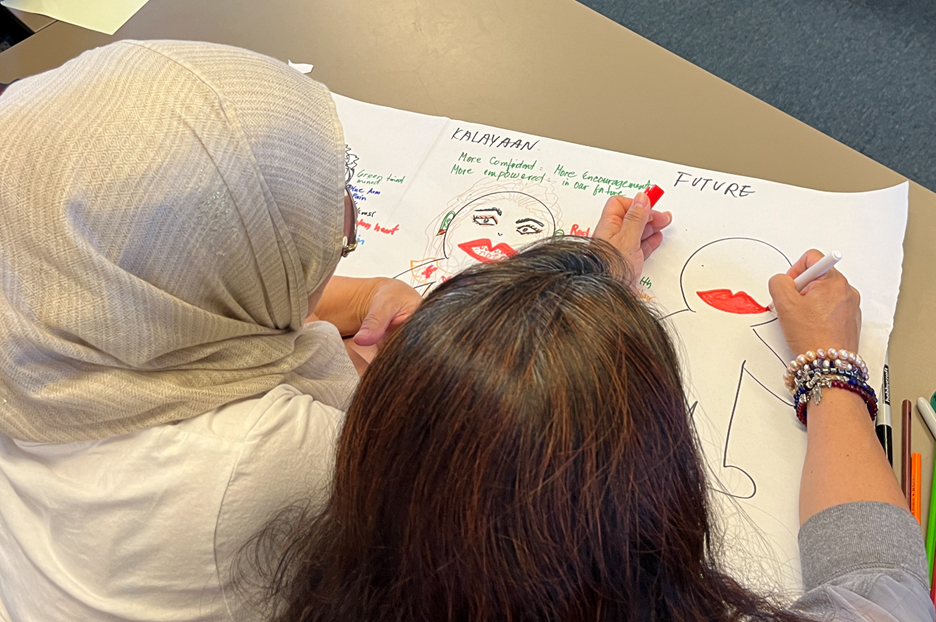
In late 2025, TSIC partnered with Kalayaan, a UK charity dedicated to justice and rights for migrant domestic workers, to explore a gentler way of understanding impact. Together, we hosted a trauma-informed body mapping workshop with eighteen members of Kalayaan’s Community Campaign programme. Rather than asking participants to fill out forms, we invited them to slow down and tune into the physical wisdom of their own bodies.
What is body mapping?
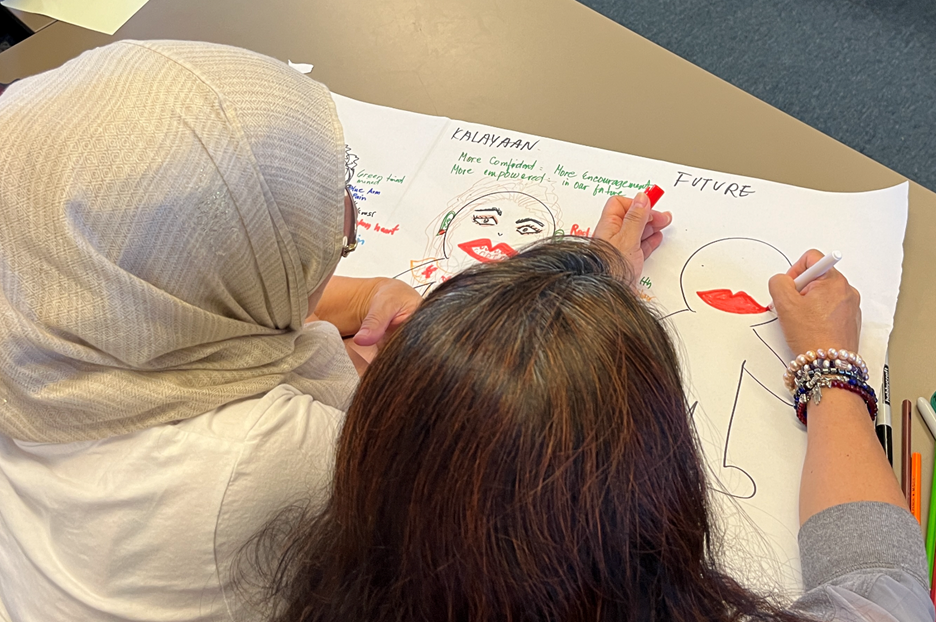
Body mapping is a somatic, creative, and participatory approach that invites people to draw their experiences onto an outline of the human body. Through colours, symbols, and simple written words, individuals map out physical sensations, emotional states, lived experiences and journeys across different moments in time.
Because stress and resilience both live in our nervous systems, body mapping allows people to express complex inner landscapes that are difficult to articulate in a spoken language, especially when it is non-native. To make the process as accessible and spacious as possible, we provided pre-drawn outlines and organised the workshop into small group tables where two to three members worked together.
We guided the reflection across three distinct physical and temporal spaces. First, we explored the past, reflecting on life before contact with Kalayaan. Next, we moved to the present, exploring what support, community, and learning feel like today. Finally, we turned toward the future, mapping out dreams, aspirations, and the quiet visions participants held for their lives ahead.
Moving, breathing, and pacing the session
When we invite people to touch upon difficult memories, it is essential that we honour the body’s need for safety and relief. We knew that drawing past stress could trigger negative memories and cause physical tension to settle back into the shoulders, chest, or stomach.
To hold space for ease, we built short somatic movement breaks into the workshop. At the beginning of the workshop, Kalayaan’s Community Engagement Lead held a grounding exercise to anchor participants’ strengths of the presence. After mapping the past, we paused, stood up together, and shook out our hands, feet, and shoulders to release stored tension. Before moving into the present and future, we breathed together, hugged each other and invited simple physical movements to embody strength and openness.
These movement breaks provided a natural rhythm for the session. They invited participants to be aware of their body sensations, discharge physical discomfort, reset their nervous systems, and physically embody the positive shifts and hopes they were about to draw.
Listening to the physical and emotional journey
As participants mapped their pasts, the imagery on paper was visibly heavy. Maps showed physical tiredness in limbs, sickness in the throat, and dark scribbles around the mind. One striking body map captured this depth of hardship with British pound symbols drawn directly inside the stomach, visually conveying how financial anxiety feels aching and upsetting, while the feet were drawn facing in no direction, capturing the disorientation of legal insecurity and fear of homelessness.
When the group shifted to mapping their present experience with Kalayaan, the visual palette lightened dramatically. Words like strong, brave, and free began to appear alongside warm yellows, greens, and reds. Scales of justice were drawn across one figure’s face to represent legal clarity, while yellow flowers blossomed around the head to signify growth and mental peace. Central to this phase was the feeling of community and shared strength. Participants drew figures holding hands and hearts grounded in friendship, reflecting how being part of the Kalayaan community made their minds lighter and their hearts full, moving from individual isolation to collective belonging.
Looking toward the future, the drawings expanded into bold visions of dignity and joy. Participants mapped out passports, visas, reunited families, and new homes. Some drew themselves wearing elegant flowing gowns and holding stylish handbags, which they explained represented stepping into leadership roles and board positions with full confidence. One participant who had initially assigned the colour black to sadness in the past chose to redefine black in the future map to mean achievement and goals.
The power of shared reflection and celebration
While we did not survey participants on whether the method was transformative for them, what we witnessed in the room as facilitators was a genuine and beautiful unfolding of human connection.
When participants were drawing, the initial quietness in the room gave way to warm and spontaneous conversation. Working in pairs and small groups, participants leant into each other’s spaces, pointing at colours, sharing stories, and offering nods of understanding. Drawing together seemed to offer a shared language of symbols and mutual empathy.
The most heartwarming moments occurred during the sharing times. As participants held up their maps to explain a colour choice or a symbol of strength, the room naturally came alive. Group members clapped, cheered, and celebrated one another’s drawings, reflections, transformations, and dreams. What began as a data-collection exercise for evaluation gradually opened up into a space of solidarity, peer validation, shared joy and hope.
Kalayaan’s Community Engagement Lead, Arundhati Chaudhuri, reflected that for many participants, the process made visible just how far they had come:
‘Journeys marked by isolation and uncertainty gave way to images of confidence, connection and hope. As one participant reflected, “I used to feel alone. Now I drew myself with a strong back and a big heart. That’s because of this community.” Perhaps most importantly, the workshop showed that evaluation can be an act of shared reflection rather than extraction. Participants were not simply recounting their experiences; they were making meaning of them on their own terms. In doing so, it became a space not only to gather evidence, but to recognise collective strength and imagine new possibilities.’
Reimagining how we evaluate
Evaluating social impact does not have to be a rigid or extractive process. When we bring somatic awareness, movement, and creative expression into evaluation, we allow people to show up as whole human beings whose lives are worth celebrating.
For evaluators and organisations alike, body mapping can offer deep qualitative insights that traditional surveys often miss. It reveals not only the practical outcomes of a service, but the human story of changes in dignity, agency, self-worth and self-determination.
If you are curious about how to bring body-aware and equity-led reflection into your organisation’s learning journey, we are here for a conversation. You can reach out to TSIC at [email protected] or learn more about Kalayaan’s vital work supporting migrant domestic workers across the UK at https://www.kalayaan.org.uk/.