

By Bonnie Chiu, Managing Director, The Social Investment Consultancy
Most social impact organisations have more data and more expert advice than ever. So why does so little of it change what happens next? A 40-year-old model offers a useful answer.
Most people who work in social impact have seen it happen. An evaluation is commissioned. The fieldwork is careful, the analysis is sharp and the recommendations are sound. The report is presented, well received and filed. Six months later, little has changed.
The evidence suggests this is common. A 2025 study of 134 development practitioners in Zimbabwe found that only a quarter said evaluation reports often led directly to changes in decisions. The barriers they rated highest had little to do with the quality of the reports. They were a lack of money to act on the recommendations and the absence of any formal follow-up once the report was delivered.
It is tempting to blame the report, or the organisation that commissioned it. In our experience, the problem is usually structural. The people who collect and manage data and the people who interpret it and make decisions tend to work apart, with different tools, different language and different budgets. Insight gets lost in the gap between them.
An old model, the DIKW pyramid, helps explain why.
Four layers, from data to wisdom.
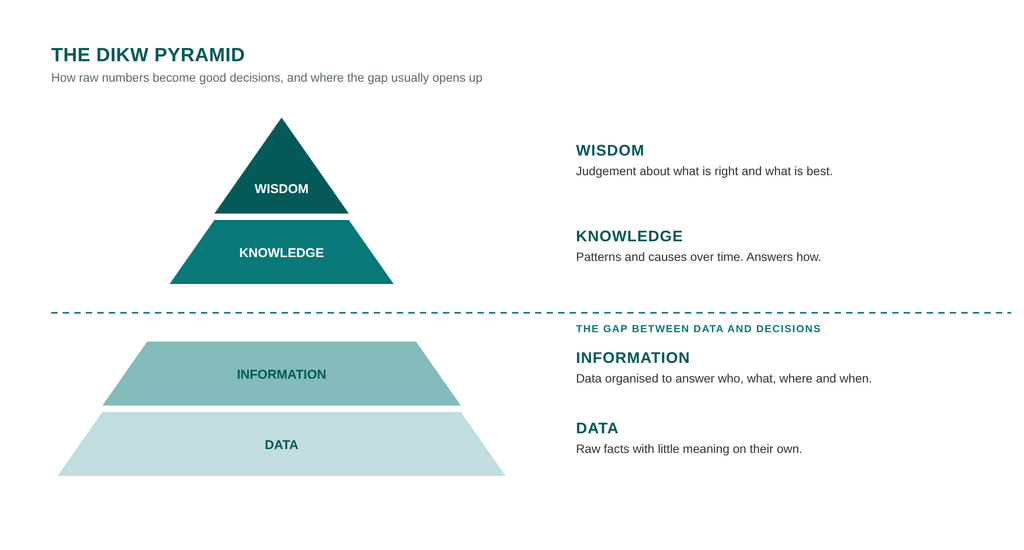
DIKW stands for data, information, knowledge and wisdom. The model is often traced to the systems thinker Russell Ackoff, who set it out in 1989. Critics point out that real life is messier than four neat layers, and they are right. But the pyramid is still a helpful way to think about how raw numbers become good decisions.
Take an illustrative programme supporting 400 smallholder farmers.
- Data is raw facts with little meaning on their own: 400, 15%, a list of dates when fertiliser was delivered.
- Information is data organised to answer who, what, where and when: “Crop yields across the programme’s 400 farms fell by 15% this season.”
- Knowledge comes from looking at patterns and causes over time. It answers how: “Yields fell most on farms where fertiliser arrived after the rains began, and the effect was worse in a drought year. Changing the delivery schedule and supporting small-scale irrigation could reverse the drop.”
- Wisdom is judgement about what is right and what is best. It asks whose priorities should shape the response, who carries the risk, and what will still be working in ten years. It might lead the programme to hand control of buying inputs to farmer groups, rather than fixing the delivery schedule from the centre.
One point matters here. Wisdom does not belong only to experts. The farmers in this example know which changes are workable, which are not, and why. Lived experience is a form of wisdom, and the people a programme serves should have a voice at every layer, not just as a source of data at the bottom.
Two ways the pyramid breaks
Data without direction. The sector has invested heavily in impact measurement platforms, dashboards, survey tools and satellite data. Much of this is valuable. But when the work stops at information, organisations are left asking: “What do we actually do with this?” Reporting becomes a compliance exercise, produced for funders more than used for decisions.
Insight that does not last. Consultants, evaluators and advisers, ourselves included, often work at the top of the pyramid. We can produce excellent strategies and frameworks. But projects end, and a report fixes insight at a single point in time while the context keeps changing. If an organisation does not have the systems, data and routines to keep acting on that insight, momentum fades. That frustrates clients, and it frustrates the people who did the work.
Why the gap persists
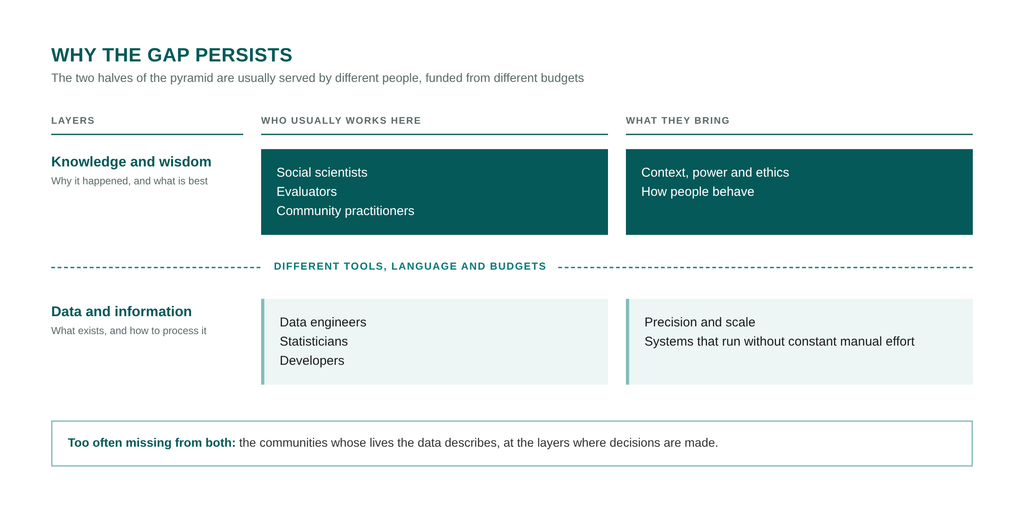
The lower and upper layers of the pyramid are usually served by different people. Data engineers, statisticians and developers bring precision, scale and systems that run without constant manual effort. Social scientists, evaluators and community practitioners bring an understanding of context, power, ethics and how people behave.
Both are essential, but they are rarely in the same team. They are often funded from different budgets, they use different vocabularies, and each can be tempted to see the other’s work as “just the numbers” or “just the story”. Meanwhile, the communities whose lives the data describes are too often absent from the layers where decisions are made.
What joining up the pyramid looks like
There is no single fix, but four practices make a real difference.
- Start from the decision, not the data. Ask what decisions the organisation needs to make over the next year, then work back to the information and data those decisions need. This cuts data collection that nobody uses.
- Build mixed teams from day one. When data specialists and social scientists scope the work together, the systems built reflect the questions that matter, and the analysis stays honest about what the data can support.
- Involve communities in making sense of findings, not just in providing data. Regular check-ins, data-sharing sessions and action learning sets let service users, community members and delivery teams interpret results alongside the evaluators. This is often where knowledge turns into wisdom.
- Leave something that keeps working, in a form people can use. Dense reports exclude some readers, including some neurodivergent people. Match outputs to their audience: a conversation, an interactive tool, a visualisation, an audio story or a short policy brief. Alongside these, leave a simple tool linked to real decisions, a routine for reviewing it and staff who feel confident using it. The test of success is whether the organisation is still acting on the insight a year later.
None of these practices is new on its own. The difference comes from doing them together.
A question to take away
Think about the last report your organisation commissioned. Where on the pyramid did it stop? Is it still shaping decisions today?
At The Social Investment Consultancy (TSIC), we are building a team that brings data, social science and participatory expertise together, so that our work keeps going after the project ends. This builds on USERS, our equitable evaluation methodology, and on Impact in Practice, our newer guide that treats evaluation as a shared, ongoing process rather than a single report. As our colleagues Emma Roberts and Yu-Shan Chiu put it, “Equity isn’t achieved through a document.”
Read more: Equity isn’t achieved through a document: designing evaluation that enhances equity impact
If this is a challenge you recognise, we would be glad to talk. Send us a message [email protected]