
From shrinking aid to new capital architectures
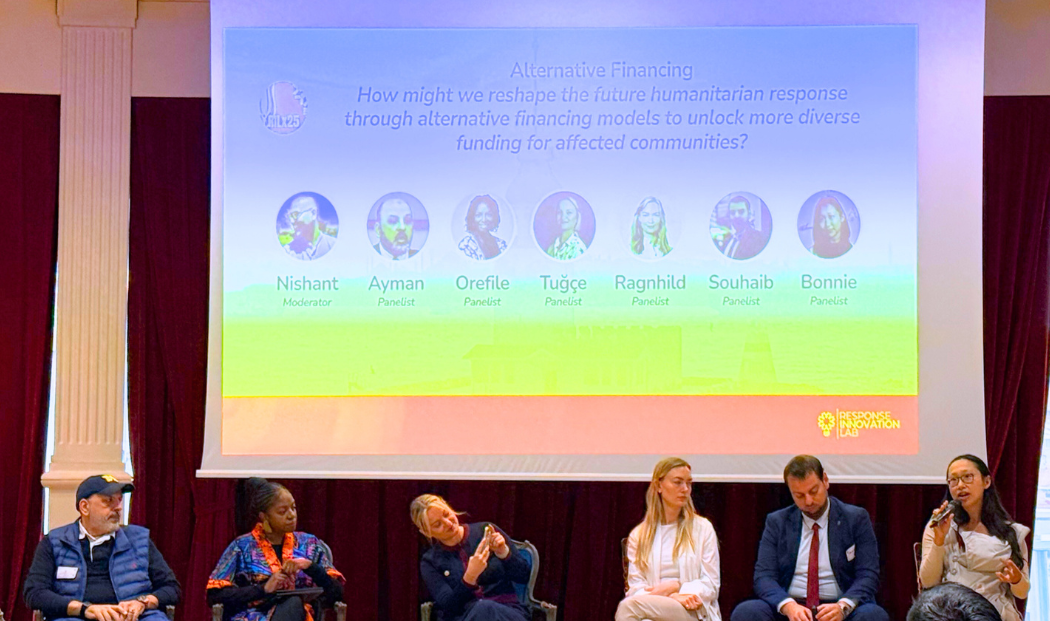
Our Managing Director, Bonnie Chiu, was invited to be part of the “Alternative Financing” panel at the Response Innovation Lab Exchange (RILx) 2025. This blog is a summary of the reflections from the panel.
The Development System at a Breaking Point
Fragile and conflict-affected contexts are at a critical crossroads. Humanitarian needs are rising, crises are becoming longer and more complex, and yet the financial foundations of the global response system are eroding.
Official development assistance is no longer keeping pace. After years of expansion, global aid budgets are now contracting, with major donors announcing multi-year cuts that are already translating into reduced humanitarian appeals, scaled-back programmes, and growing financing gaps. These reductions are not temporary shocks; they reflect deeper fiscal and political pressures that are reshaping the aid landscape.
At the same time, expectations that the private sector will simply “step in” remain largely unmet in fragile and conflict-affected settings. Commercial capital is highly sensitive to political risk, currency volatility, weak institutions, and unclear exit pathways.
This moment is not just a funding shortfall. It is a systems challenge. The question is no longer how to raise more money within existing models, but how to redesign the financial architecture underpinning humanitarian response, recovery, and development.
At TSIC, we see alternative financing not as a replacement for aid, but as a necessary evolution of how capital is mobilised, structured, and governed in contexts where traditional approaches are no longer sufficient. In this blog, we explore three opportunities that we think hold huge promise in how we rewire the financial architecture of aid – to one that truly builds wealth and sustains across fragile and conflict-affected contexts.
Social Enterprise as a Response to Market Failure
One of the most significant shifts underway is the growth of social enterprises operating in fragile contexts. Increasingly, organisations that once relied primarily on grants are adopting enterprise models to address persistent market failures in areas such as livelihoods, basic services, and climate resilience.
Examples such as Adeso’s transition from a traditional NGO to a social enterprise reflect this broader trend. These organisations are not abandoning impact in pursuit of revenue; they are seeking financial models that allow them to operate with greater sustainability, flexibility, and scale.
This evolution aligns with long-standing hypotheses advanced by actors such as Acumen: that patient, impact-oriented capital can unlock solutions where markets are incomplete and public provision is insufficient. Social enterprises create a natural entry point for alternative finance, particularly when paired with concessional or blended capital that recognises the real risks of operating in fragile environments.
For investors and funders alike, this signals a growing pipeline of organisations that are neither purely charitable nor conventionally commercial, but which require purpose-built financial instruments to thrive.
Diaspora Capital as Enduring Commitment
While many forms of capital retreat in times of crisis, diaspora communities often continue to give. Across fragile and conflict-affected contexts, diaspora remittances and informal support remain among the most resilient financial flows, frequently exceeding official aid and foreign direct investment.
Diaspora capital is distinct. It is patient, relationship-driven, and anchored in long-term commitment to people and places rather than short-term returns. Yet it remains largely informal and under-structured, channelled through remittances or ad hoc crowdfunding rather than investible vehicles.
This represents both a missed opportunity and a design challenge. With the right financial products, regulatory frameworks, and trusted intermediaries, diaspora capital could play a far more strategic role in financing SMEs, social infrastructure, climate adaptation, and inclusive job creation in fragile settings.
At TSIC, our work with partners such as AFFORD UK through initiatives like the AFFORD Venture Studio reflects a deliberate effort to move diaspora finance from the margins into the core of alternative financing architectures.
Blended Finance as a Bridge
Blended finance has gained increasing traction as a mechanism to bridge the gap between public purpose and private capital. By using concessional funding, guarantees, or first-loss capital to absorb risk, blended structures can mobilise investment that would not otherwise engage in fragile and conflict-affected contexts.
Importantly, blended finance is not about forcing private capital into unsuitable environments. It is about sequencing capital intelligently. Donor funding can set standards and absorb early risk. Development finance institutions can provide scale and discipline. Private investors can participate where risks are mitigated and impact is credible.
Demonstration matters. As more blended vehicles move from pilot to performance, confidence grows across the ecosystem. But success depends on rigorous structuring, transparent impact governance, and a clear understanding of where blended finance adds value and where it does not.
From Funding Gaps to Capital Architecture
The shift toward alternative financing is already underway. The question now is how to ensure it strengthens, rather than fragments, response systems in fragile and conflict-affected contexts.
From TSIC’s perspective, three priorities stand out:
First, design must precede scale.
Alternative finance fails when instruments are copied without regard to context. Capital structures must be tailored to local risk, institutional capacity, and political economy, rather than imported wholesale from more stable markets.
Second, capital must be sequenced, not substituted.
The future is not about replacing aid with private investment, but about aligning grants, guarantees, concessional capital, diaspora finance, and commercial investment into coherent pathways that crowd capital in while safeguarding impact.
Third, impact governance must be embedded.
In fragile contexts, the consequences of poor design are high. Robust impact measurement, accountability mechanisms, and conflict-sensitive standards are essential to avoid extractive outcomes and ensure capital contributes to long-term resilience.
Fragile and conflict-affected contexts are indeed at a crossroads. Shrinking aid is forcing a reckoning, but it is also creating space to rethink how capital is mobilised and deployed. Alternative financing, when treated as architecture rather than experimentation, offers a pathway forward that is realistic about risk, disciplined about impact, and grounded in long-term systems change.
Read more about TSIC’s experiences in Innovative Finance.