
By Claudia Useche Trujillo, Senior Consultant at TSIC
The World Day of Social Justice calls us to critically examine the world we inhabit. It is a world characterised by the extreme accumulation of wealth in a small elite, economic systems that normalise exclusion, structural corruption, ongoing violence, a climate crisis exacerbating existing inequalities, forced migration becoming more common, and democracies that seem increasingly fragile.
This is not the background to social impact work. It is the ground on which that work takes place. And it is also the ground from which we measure.
In recent years, the sector’s language has shifted. We talk much more openly about systems change, structural causes and overlapping crises. We recognise that projects do not operate in a vacuum and that change is rarely linear or fully controllable. This shift matters. It reflects real learning. We no longer evaluate as if the world were stable.
And yet, there is a paradox we rarely pause to sit with. We speak more about systems change precisely when many systems are fractured, unstable, or no longer functioning as they once did. We name complexity and systemic failure, while continuing to measure impact through tools, timelines and expectations built for far more predictable worlds than the one we now inhabit.
Acknowledging context, important as it is, does not resolve a deeper question.
What power do we exercise when we measure impact in this context?
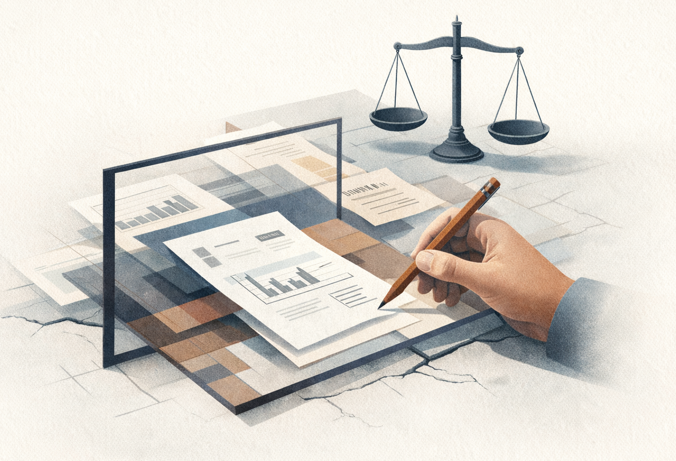
Measurement is not only about describing reality. It is about deciding what becomes visible, what counts as evidence, and what remains outside the frame. It is about who interprets findings and, crucially, what happens once those findings exist.
This becomes very clear in practice. Findings emerge that do not sit comfortably with expectations. Impacts appear to be ambiguous rather than clearly positive or negative. Tensions surface. Unintended consequences come into view. At that point, a quiet but decisive negotiation often begins. Between what we have found and what is expected. Between what could be said and what feels safe to say. Between learning and not unsettling things too much.
This is the moment when measurement stops being technical and becomes an exercise of power.
Not because context has been ignored. In many cases, it is well understood. The issue is that control over meaning and over the use of results often remains concentrated. Communities may participate. Local teams may contribute data and insight. But they do not always take part in interpretation or in the decisions that follow. When measurement does not lead to real change, its legitimacy weakens, no matter how rigorous the process may have been.
This is where justice stops being an analytical lens and becomes a practical question.
What happens after we measure?
Taking justice as a foundation for impact measurement means accepting that measurement has consequences. It cannot exist only to document or to justify. It must have the capacity to influence real decisions, even when that is uncomfortable, slows things down, or requires a change of direction.
In practice, this means being explicit from the start. What kinds of findings could trigger change? Who will interpret the evidence? Which decisions are genuinely open to being revisited? It also means accepting that not all learning can be translated into neat recommendations or clear conclusions.
In the global context we are living through, continuing to measure without asking what power we are exercising, and to what end, is not neutral. It quietly reinforces the existing order.
Measuring impact from a justice perspective is not about adding an ethical layer at the end of a process. It is about recognising, from the outset, that measuring is an exercise of power and deliberately choosing how that power is used.
A call to action and to debate
Taking justice as the foundation for impact measurement is not a question of style or methodological preference. It is a question of responsibility.
The invitation is practical.
For those who design evaluations, for those who fund them, and for those who make decisions based on evidence. Let us ask not only whether we are measuring well, but what we are willing to change when what we measure is uncomfortable.
Let us create space for findings that challenge strategies rather than confirm them. Let us loosen the concentration of interpretive authority. Let us accept that measuring with integrity may require real consequences.
This is not a call to have all the answers. It is a call to hold disagreement, complexity and tension as legitimate parts of learning.
If social justice is the horizon we claim to work towards, impact measurement cannot be limited to describing the world as it is. It must be willing to put that world under pressure.
The conversation is open. Not to repeat familiar language, but to decide, together, what kind of power we want to exercise when we measure impact.