

By Bonnie Chiu, Managing Director, TSIC
Global development and the social impact sector stand at a critical juncture. As I explored in a recent blog for IVAR, civil society is hurtling toward one of three distinct futures: one that is hyper-financialised, one that is deeply fragmented, or one that is meaningfully re-mutualised.
Across all three scenarios, civil society achieves remarkable things every single day. We launch new programmes, expand community services, and plug safety-net gaps. So much of this work is inherently incremental – it often needs to be. Incremental progress is also what we know best to measure.
Yet, when set against the scale of systemic breakdown, a troubling paradox emerges: if civil society is achieving and measuring so many real wins every single day, why does the status quo remain so stubbornly entrenched? This disconnect forced me to pause and interrogate incrementalism itself—to ask whether our hard-won, highly measured progress is actually building a bridge to systemic transformation, or simply making a failing system tolerable.
A Blind Spot: The Baseline is Constantly Changing
Five years from our journey evaluating systems change, we now realise that all along, we’ve been missing a core component – the trajectory of change.
While we’ve evolved the linear evaluation frameworks to embrace more complex, relational approaches—including measuring power dynamics, network health, and stakeholder capability—
our experiences in the past five years have told us that system-level metrics alone are incomplete without directionality.
As Liz Ruedy articulated for Democracy Fund, traditional impact models assume a flat status quo—evaluating programmes against an imaginary baseline where nothing changes unless we intervene. But real systems are dynamic, fluctuating, and frequently deteriorating under structural headwinds. Even advanced systems frameworks often take a static snapshot of power or relationships at a single point in time.
Trajectory means evaluating an intervention not against a fixed baseline, but against the direction the system is already travelling in.[B(1] It forces us to ask two questions of any piece of work: where is this system heading anyway, and does what we are doing make the change we want more likely or less likely over time?
What We Know From Other Disciplines
In order to truly change systems, we need to ask ourselves deeply: Is incremental progress a necessary stepping stone toward systems change, or does it actively prevent systems change from taking place?
Surprisingly, I found very few answers in the impact space. I tried charting a graph, which looks like the below:
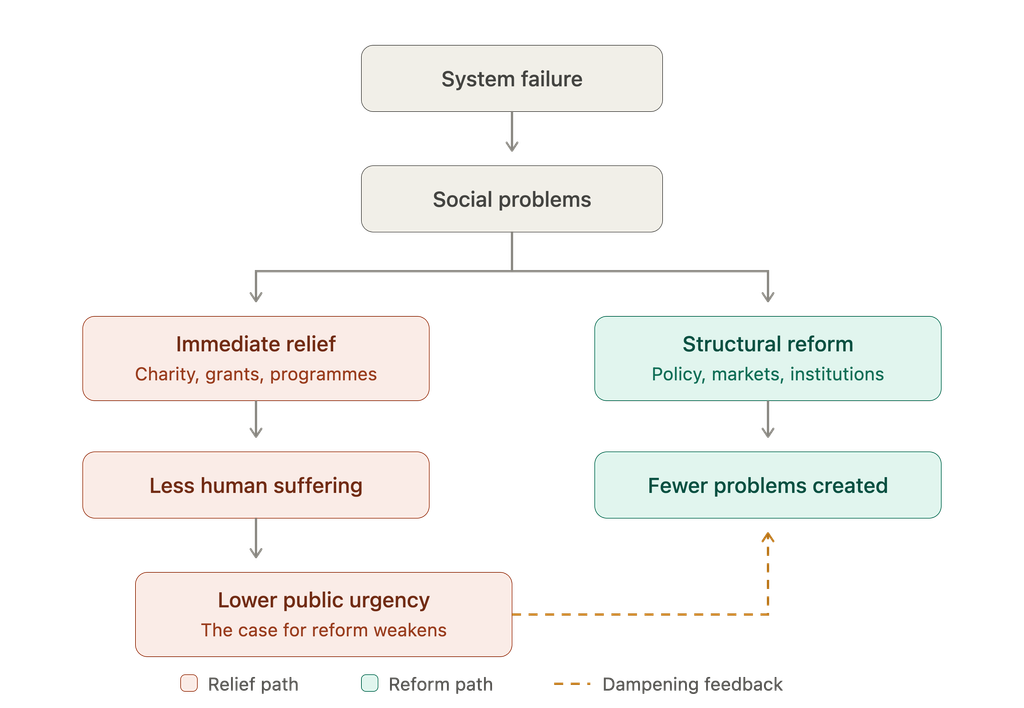
The question is therefore, how do the dynamics work, and how can immediate relief (which is necessary) not become a roadblock to structural reform?
So I turned to other disciplines, such as psychology and systems dynamics. There is not a single, uniform answer—instead, they predict two opposing outcomes depending entirely on the structural conditions under which incremental work takes place.
Incrementalism can work to change systems:
- The Progress Principle (Amabile): Teresa Amabile’s work demonstrates that people are most motivated when experiencing “small wins”. Intermediate victories provide proof of concept, maintain morale, and build coalition momentum. Without observable progress, movements suffer from exhaustion and disengagement. Here, incrementalism is psychologically necessary.
- Learned Helplessness (Seligman): Martin Seligman’s research reveals that repeated exposure to failure leads stakeholders to stop trying altogether. If social initiatives demand all-or-nothing structural overhauls without deliverable short-term wins, the resulting perceived failure causes public and donor withdrawal, halting systems change.
But it can also stabilise the status quo or even actively prevent it:
- System Justification Theory (Jost): Conversely, John Jost demonstrates that human beings possess a powerful drive to rationalise and defend existing social systems. When an intervention delivers small improvements, it satisfies this psychological urge, leading stakeholders to conclude that “the system is working” or “the government is listening”. This pacifies outrage, neutralises radical demands, and turns incrementalism into a stabilizing buffer for the status quo.
- Prospect Theory (Kahneman & Tversky): Daniel Kahneman and Amos Tversky showed that people take significant risks when facing losses, but become risk-averse when perceiving gains. Alleviating acute suffering shifts public perception away from “loss,” sharply decreasing societal risk appetite for the disruptive disruption required for deep structural reform.
- Systems Homeostasis (“Shifting the Burden”): Complex systems naturally seek equilibrium. When an intervention relieves immediate distress, it acts as a pressure-release valve. The system absorbs the relief and restores stability without adapting its underlying rules or power distributions. The relief effort succeeds, but because it succeeds, the urgency driving structural reform vanishes.
Hypothesising Two Forms of Incrementalism
Reflecting on these behavioural and systemic dynamics, it becomes clear that incrementalism is not a monolith. Rather than debating whether small wins are inherently “good” or “bad,” we can hypothesise two distinct modes of incremental progress: Generative and Palliative.
While this distinction might sound theoretical at first, its practical purpose is simple: it allows us to evaluate the direction an intervention is setting for the system over time.
- Generative Incrementalism: Small, deliberate wins designed so that each victory actively builds community power, deepens alliances, opens institutional doors, and shifts resources toward root causes. Here, immediate progress acts as a catapult—making larger, structural transformation increasingly likely over time.
- Palliative Incrementalism: Small wins that successfully ease acute distress but leave underlying incentives, power dynamics, and institutional rules untouched. While morally necessary to reduce immediate suffering, over time these interventions act as a pressure-release valve. They reassure the public that “something is being done,” quieten urgency for systemic reform, and lock us into a cycle of perpetual symptom management.
The Ingredients of Trajectory
What actually determines whether an initiative is tipping toward generative transformation or palliative care?
We suggest there are five core “ingredients” operating beneath the surface of any social intervention. Auditing these ingredients allows us to see whether our daily work is building structural leverage or simply buffering the status quo:
1. Citizen Agency & Power
- The Question: Does the intervention treat people as passive beneficiaries of a service, or does it build their collective capacity, leadership, and power to advocate for themselves?
- The Trajectory Lever: Generative work uses immediate delivery as an organising mechanism, turning recipients into active civic stakeholders.
2. Coalition Density & Alignment
- The Question: Does the initiative operate in institutional isolation, or does it knit together broad, cross-sectoral alliances around a shared long-term agenda?
- The Trajectory Lever: Generative work builds collective infrastructure, shared data, and unified advocacy vectors that outlast any single grant cycle.
3. Institutional Openness & Structural Access
- The Question: Does the initiative accept existing rules and policies as fixed constraints, or does it create legal, policy, and decision-making access points for systemic reform?
- The Trajectory Lever: Generative work uses present access to challenge legal precedents, reform policy architectures, and reshape market rules.
4. Resource Reallocation
- The Question: Does success create a permanent financial dependency on philanthropic or public funding to keep managing the problem?
- The Trajectory Lever: Generative work explicitly shifts capital, talent, and public funding away from emergency response and toward long-term root-cause resolution.
5. Narrative & System Legitimacy
- The Question: Does reporting immediate success reassure the public and decision-makers that existing institutions are functioning acceptably?
- The Trajectory Lever: Generative work pairs short-term relief with bold narrative framing that explicitly links immediate suffering to underlying structural policy failures.
None of this asks us to stop the work we are already doing. It asks us to look at that work differently, and to be honest about which parts of it are building toward something and which parts are holding a line. Most portfolios will contain both, and there is no shame in that. What matters is whether the balance between the two is a deliberate choice or an accident of how we have always measured success.
Doing great work is no longer enough if that work leaves the status quo intact. By moving beyond standard metrics and looking beneath the surface at agency, coalitions, institutional access, resources, and narrative, we can stop serving as a pressure-release valve for failing systems—and start designing immediate interventions that build true structural leverage.
In my next post, I’ll share a practical diagnostic framework we’ve developed to help funders, strategists, and civil society leaders audit their portfolios and re-engineer immediate relief into generative structural change. Does this resonate? Have we missed anything? Please share and we are open to your thoughts!